Urban Farming Grows Jobs, Community, Food
August 2014 
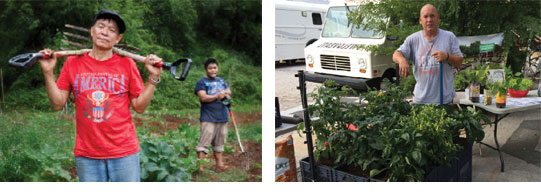
Caption: On the left are two participants of Decatur's Kitchen Garden, which is part of the Global Growers Network. On the right is Markus Gaffney, founder of the Veteran's Farmers Market and The 3X3 Project.
The most basic and routine part of our day — access to food — involves one of the most complex planning processes.
Food is many things. It is culture, embodying ethnic traditions, family recipes and social opportunities. It is wellness – the fuel that we need to stay healthy and the nutrients we need to thrive. It is a commodity – it represents job creation, economic development and innovation. And, food is sustainability, insofar as we strive to create food security for all residents of metro Atlanta, providing diverse options while minimizing harmful environmental impacts.
ARC addresses the need for accessible, healthy foods for all residents of the region through components of its PLAN 2040 Regional Resource Plan, which focuses specifically on opportunities for local food production activities. More specifically, one of the six criteria adopted by the ARC Board to provide guidance in selecting priority resources within the region is the need to “preserve significant working agriculture or forest resources or to create opportunities for local food production activities.”
According to the U.S. Department of Agriculture, agricultural production
in Georgia topped more than $9 billion in 2012, making it our state’s number one industry. Yet the vast majority of metro Atlanta’s food comes from outside the region and the state. That imbalance has begun to change in recent years as access to locally-sourced food has grown. By the numbers, we enjoy the harvest from more than 200 urban farms, some 80 community gardens and urban orchards and more than 90 farmer’s markets.
In addition, Community Supported Agriculture (CSA) programs provide for direct investment into the local growing community, regular access to fresh fruits, vegetables and pasture-raised meats, as well as opportunities for dining in restaurants that purchase directly from local growers. The Georgia Department of Agriculture supports Georgia Grown, a marketing and economic development program to brand and promote locally grown products, as well as a Georgia Agritourism program that promotes value-added services on local farms.
A variety of unique urban agriculture programs is also sprouting in the region. The Global Growers Network was founded by Basmat Ahmed, who fled South Sudan during government-sponsored genocide. The Network turned an underused park near Clarkston into a community garden for refugees and the disabled. The garden is now a place where they can grow vegetables from their homelands and share them with the community. The garden offers a place where refugees can connect with others and with the earth. Gardeners find not only the peace, camaraderie and nourishment of farming, they also receive agricultural training and earn money by selling excess produce at area farmer’s markets.
Adjacent to Atlanta’s downtown business district in the Castleberry neighborhood and modeled on the concept of World War II Victory Gardens is the Veteran’s Farmers Market. The U.S. Department of Veterans Affairs estimates that there are more than 6,000 displaced veterans on Atlanta streets. The 3 x 3 Project, which operates the Veteran’s Farmers Market, gets those veterans involved in urban farming. A portion of the food helps supplement local shelters, and some proceeds help provide job and agriculture training for veterans.
In the southern part of the region, community gardeners created Community Gardens of Henry County, a nonprofit organization that operates five main gardens on vacant lots throughout the county. These gardens provide many positive things for the communities including education, training, food production and attractive green space.
While community gardens and urban farming are making a positive impact on many metro regions around the U.S., they also face a variety of challenges. These include high water rates, a lack of capital to start and maintain gardens and a scarcity of available space due to competition for vacant lots from more profitable ventures.
Locally-grown food provides fresh, nutritious sustenance for regional residents. The process of raising it provides jobs, physical activity, community building and business opportunities for citizens. Even though it has its challenges, urban agriculture in metro Atlanta has put down strong roots. The forecast is for a bumper crop.
|