In This Edition of Econ. Info:
Green Dividends
Feature Article
New York City's Green Dividend
Regional Connection
New Century Economic Development Plan for the City of Atlanta
Idea Corner
Green Ribbon Committee
New Resources
Feature Article
New York City's Green Dividend
CEOforCities.org
 When does a bike lane become an economic stimulus? When it's part of an alternative transportation system that puts $19 billion into New York City's economy each year. When does a bike lane become an economic stimulus? When it's part of an alternative transportation system that puts $19 billion into New York City's economy each year.
Because New Yorkers drive substantially less than the average American, they realize a staggering $19 billion in savings each year — money that their counterparts in other large U.S. metro areas spend on auto-related expenses. This is the principal finding of New York City’s Green Dividend, a report by CEOs for Cities for the New York City Department of Transportation.
New York City’s Green Dividend is based on a conservative calculation of the average cost of operating an automobile. The average New Yorker drives nine miles per day. That’s 16 miles fewer per day than the average resident of the largest U.S. metros. At 40 cents per mile, New Yorkers are collectively saving a staggering $19 billion on auto-related expenses.
“New York City has always been the leader in America on low per capita energy consumption, and a big reason for that is the way New Yorkers travel around their city,” noted Carol Coletta, president and CEO of CEOs for Cities. “Now we know what that’s worth to New Yorkers in dollars and cents. It turns out that less driving means that a lot more money is circulating in the local economy.”
Read entire article
Local Connections
New Century Economic Development Plan for the City of Atlanta
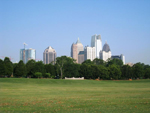
Atlanta’s New Century Economic Development Plan is notable in making a direct linkage between parks and greenspace and economic development. Parks and greenspace provide proven economic benefits, such as attracting businesses through improved quality of life, spurring economic activity associated with park and greenspace resources (e.g., tourism), increasing property values, reducing costs for engineered infrastructure and lowering energy costs as a result of trees and other vegetation.
A key question is how these benefits can be most effectively leveraged through the integration of public greenspace into city-sponsored economic development initiatives (e.g., by considering greenspace part of the basic infrastructure package in Tax Allocation District projects) and requires setting measurable benchmarks for specific types of greenspace. The City of Atlanta has a goal of adding 1,900 acres of dedicated parks and greenspace to the city (an increase of 56%.) It plans to do so through actions, such as:
- Streamlining the process for land acquisition and donations;
- Partnering with organizations to create a "world class" park system;
- Evaluating the creation of an effective governance structure to improve operations and acquisitions of the City of Atlanta parks;
- Creating standards for greenspace inclusion in all major capital projects, both public and private; and
- Identifying potential sources of funding required to grow dedicated parks and greenspace.
Idea Corner
Green Ribbon Committee
Roswell Green
 The City of Roswell’s Green Ribbon Committee, lead by Councilmember Kent Igleheart, is a group of community stakeholders who volunteer their time and expertise to assist the City of Roswell with sustainability visioning and planning efforts. This group of volunteers offers assistance with researching policies and/or new ordinances that support their mission, “to increase environmental accountability, to teach the principles of sustainable living and to implement innovative programs that protect the environment, provide economic savings and enhance our quality of life.” The City of Roswell’s Green Ribbon Committee, lead by Councilmember Kent Igleheart, is a group of community stakeholders who volunteer their time and expertise to assist the City of Roswell with sustainability visioning and planning efforts. This group of volunteers offers assistance with researching policies and/or new ordinances that support their mission, “to increase environmental accountability, to teach the principles of sustainable living and to implement innovative programs that protect the environment, provide economic savings and enhance our quality of life.”
New Resources
Creating Quality Jobs: Transforming the Economic Development Landscape
As the role of economic developers has expanded to include everything from technology transfer to attracting retail to expanding a community’s tax base, the profession must examine the types of jobs it is creating and how well they meet the needs of individuals and communities in a globalized, skill-based economy. Yet relatively little research has gone into exploring the issue of quality job creation from the economic developers’ viewpoint. Creating Quality Jobs: Transforming the Economic Development Landscape aims to fill that gap and identify the role of economic developers in creating quality jobs and improving the quality of existing jobs.
Backdoor Retailing: Alternatives to Traditional Storefront Sales
Backdoor retailing refers to sales that occur through alternative channels, typically supplementing those generated by walk-in business. Downtown merchants with backdoor operations are able to increase and diversify their customer base beyond the market potential of downtown customer traffic.
Businesses with backdoor operations typically sell to:
- Local businesses, organizations and even municipal agencies. These transactions and relationships often fit downtown sustainability strategies.
- Retail consumers, from the local area or beyond, who do not purchase on site as walk-ins.
To learn more about backdoor retailing. |